
Commercial Refrigerator Buying Guide for Kenyan Businesses
Updated August 2026 · Frosten Energy Solutions Engineering Team
Choosing a commercial refrigerator is less about picking a model off a spec sheet and more about matching equipment to how your business actually operates — what you store, how much, how often it's accessed and what happens if the unit fails. This guide walks restaurants, hotels, supermarkets, food businesses and institutions through the factors that should drive a commercial refrigeration purchase.
Refrigeration Capacity & Storage Requirements
Capacity should be set by peak stock volume and delivery frequency, not by guesswork or available floor space alone. A kitchen that takes large weekly deliveries needs more buffer capacity than one restocking daily from a nearby supplier, and undersizing a unit tends to show up quickly as overcrowded shelves, blocked airflow and inconsistent temperatures.
Operating Environment & Temperature Requirements
Ambient kitchen heat, humidity and how close a unit sits to ovens, fryers or direct sunlight all affect how hard the compressor has to work to hold temperature. Units rated for tropical or high-ambient conditions cope better with hot back-of-house environments than standard-rated equipment, and the required holding temperature — chilled or frozen — should be confirmed for the specific product being stored rather than assumed.
Equipment Configuration
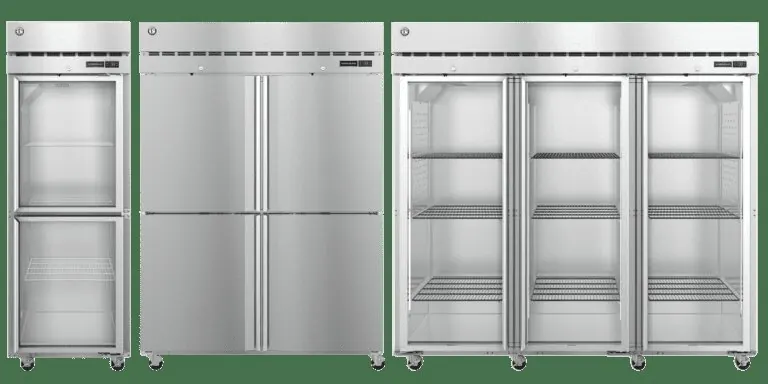
Upright reach-in units, under-counter fridges, walk-in cold rooms and display/multideck chillers each suit different workflows. A busy prep line usually benefits from reach-in units positioned at the point of use, while bulk storage is often better served by a walk-in room — see our cold room installation cost guide if a walk-in room is on the table. Getting configuration right reduces staff movement and keeps doors open for less time.
Access Frequency
How often a unit is opened during service changes both food safety risk and energy consumption — every door opening lets warm, humid air in and forces the compressor to recover. High-traffic prep stations benefit from units with tighter door seals and faster recovery, while back-of-house bulk storage that's accessed less often can prioritise capacity over recovery speed.
Energy Efficiency
Commercial refrigeration typically runs 24/7, so efficiency differences compound over the life of the unit. Inverter-driven compressors, better insulation, efficient door seals and correctly sized condensing units all reduce running cost — it's worth weighing energy efficiency alongside the purchase price rather than focusing on upfront cost alone.
Installation Requirements
Plug-in reach-in units need adequate electrical capacity, ventilation clearance around the condenser and a level, stable floor. Walk-in rooms and larger refrigeration plant need proper site assessment covering electrical supply, condensing unit placement and structural considerations — this is engineering and electrical work that should be carried out by qualified technicians rather than treated as a DIY installation.
Maintenance & Hygiene
Commercial refrigeration needs routine cleaning of interior surfaces, door seals and condenser coils to hold temperature efficiently and meet food-hygiene expectations. Equipment that's difficult to clean — tight corners, hard-to-reach coils — tends to get neglected, which shortens compressor life and increases breakdown risk over time.
Warranty, Service & Total Cost of Ownership
The purchase price is only part of the real cost. Warranty length and what it actually covers (parts, labour, compressor), local spare-parts availability, and the running cost implied by the unit's efficiency all factor into total cost of ownership. A cheaper unit with poor local parts support or high energy draw can end up costing more over its working life than a better-specified alternative.
What to Weigh Before You Buy
Across every purchase, these are the factors that should shape the decision.
Set by peak stock and delivery frequency, not floor space alone.
Chilled vs. frozen storage requirements for the specific product.
Kitchen heat and humidity affect compressor duty and recovery.
Reach-in, under-counter, walk-in or display, matched to workflow.
How often the unit opens during service affects recovery and hygiene.
Running cost compounds over 24/7 operation — weigh it against price.
Confirm supply and circuit capacity before installation.
Coverage terms and local spare-parts availability matter as much as price.
Frosten's Starting Rate for Commercial Refrigerators
This is Frosten's published starting rate for commercial refrigeration units. Final pricing depends on capacity, configuration and specification, confirmed after discussing your requirements.
How to Compare Commercial Refrigerator Quotations
Once you have quotations in hand, compare them on complete scope rather than the headline price alone. Two quotations with different specifications or scopes aren't directly comparable just because both contain a number \u2014 a lower price often means a smaller unit, a lighter-duty compressor, or a narrower scope of installation and support.
Look for a clear breakdown of the exact equipment model and specification, storage capacity, and the operating temperature or application it's rated for. Check how the configuration is described \u2014 reach-in, under-counter, walk-in or display \u2014 and whether energy efficiency (inverter compressor, insulation standard) is stated rather than left implied.
Beyond the unit itself, confirm what's included: delivery, installation scope, and commissioning where applicable. Warranty terms should state their length and exactly what they cover \u2014 parts, labour, compressor \u2014 alongside spare-parts and after-sales service support. A trustworthy quotation also states clearly what's excluded, and whether VAT or other taxes are already included in the figure or added separately.
Requesting this level of detail from every supplier you compare makes it possible to judge quotations on equal terms, rather than on price alone.
Explore Frosten's refrigeration & HVAC services
Cold rooms, walk-in coolers and refrigeration equipment for Kenyan businesses. Visit Commercial Refrigeration →
Scheduled servicing to protect refrigeration equipment and catch issues early. Visit Maintenance →
VRF/VRV, ducted and split systems for residential, commercial and industrial buildings. Visit HVAC Design & Installation →
More from Frosten's Guides
Cold Room Installation Cost in Kenya
What drives cold room installation cost in Kenya, and how to compare quotations.
Cold Chain Refrigeration for Pharmaceutical Storage
Planning considerations for temperature-sensitive and pharmaceutical cold-chain storage in Kenya.
Frequently Asked Questions
What size commercial refrigerator do I need?
Size should be based on peak stock volume and how often you take deliveries, not on available floor space alone. A site assessment is the most reliable way to confirm the right capacity for your operation.
Is a walk-in cold room better than reach-in units?
It depends on volume and workflow. Reach-in units suit point-of-use storage on a prep line, while walk-in rooms suit bulk storage. Many commercial kitchens use both.
How much does a commercial refrigerator cost in Kenya?
The price for commercial refrigeration units depends on the unit type, capacity, configuration and number of units. Request a quotation based on your requirements, and Frosten will confirm the price for your project.
How often should commercial refrigeration be serviced?
Coils, seals and controls should be checked on a routine schedule — see Frosten's maintenance plans for recommended intervals for commercial equipment.
Need help choosing the right commercial refrigerator?
Frosten Energy Solutions can assess your storage needs and recommend equipment sized to your business.
Request Quotation